How to Stop Charley Horses (In Your Calves and Everywhere Else)
The Question
One of our members asked me this: "How do you prevent charley horses in your calves?"
If you've ever been jolted awake at 2 a.m. with your calf locked up like a fist, you know why they asked. And calves aren't the only place it happens. Hamstrings, feet, toes, quads, even hands can seize up.
The usual advice is "drink more water, eat a banana, and stretch." That helps some people some of the time. But cramps have more than one cause, and if you only ever try those three things, you might never fix yours.
So let's go deeper: what a cramp actually is, how to stop one fast, and how to figure out what's causing yours.
What a Cramp Actually Is (Hint: Probably Not Your Potassium)
A cramp is a muscle that contracts hard and won't let go. For years, the go-to explanation was dehydration or low electrolytes like potassium and sodium.
The research tells a different story. When scientists studied 210 Ironman triathletes, the ones who cramped weren't more dehydrated and didn't have lower sodium than the ones who didn't. What predicted cramping was pushing harder than usual and having a history of cramps.
The leading explanation today is muscle fatigue messing with your nerve signals. When a muscle gets tired, the signal telling it to contract gets louder and the signal telling it to relax gets quieter. The muscle locks up.
That explains a lot. It's why cramps show up late in a tough workout, during a new kind of training, after a long day on your feet, or at night in a muscle that worked hard all day. Hydration and minerals still matter for some people, but they're one piece of the puzzle, not the whole thing.
How to Stop a Cramp Right Now
The rule is simple: gently lengthen the muscle that's cramping. Stretching it sends a "relax" signal that breaks the cramp, usually within seconds to a minute.
Calf: Pull your toes toward your shin, or stand up and press your heel into the floor.
Foot or toes: Pull your toes up and back, or stand and put weight on the foot.
Hamstring (back of thigh): Straighten your leg and gently reach toward your toes.
Quad (front of thigh): Pull your heel toward your butt.
Hand or fingers: Spread your fingers wide and press your palm flat on a table.
A few things help the stretch along. Gently massage the muscle, walk it off once it lets go, and use heat afterward if it's still sore.
The pickle juice trick is real. In one study, cramps stopped about 49% faster after people drank a small amount of pickle juice. It worked too quickly to be the salt reaching the muscle. Researchers think the strong taste triggers a reflex that calms the nerve signal, which backs up the idea that cramps start with your nerves.
Find Your Cause
Start by noticing when and where your cramps happen. The pattern points you toward the cause.
During or late in a workout: Muscle not strong or conditioned enough for the work, a sudden jump in training, not enough fuel.
At night: Muscles kept in a shortened position, a long day on your feet, age, certain medications.
Always on the same side: A strength or mobility imbalance, or something worth getting checked.
After a stressful stretch of days: Tension, poor sleep, skipped meals and water.
Now let's look at each group of causes.
Your training
The muscle isn't ready for the job. A muscle that's undertrained for what you ask of it tires out early, and tired muscles cramp. This is one of the most common causes we see.
Imbalanced training. When one muscle group does more than its share, it fatigues first. Strong quads with weak hamstrings, calves doing the work your hips should be doing, or one side of the body stronger than the other can all set up the overworked muscle to cramp.
Too much, too soon. A sudden jump in volume or intensity is a classic trigger. Think of a new class with lots of jumping, your first week back after time off, or a vacation spent walking all day.
Limited mobility. If a joint doesn't move well, the muscles around it work in a cramped, shortened range all day.
Your daily life
Hours on your feet, especially on hard floors, wear out your calves and feet.
Shoes. Switching to flatter shoes, wearing worn-out ones, or going from heels to flats can suddenly load muscles that aren't used to it.
Shortened positions. Sitting for hours, wearing heels, and sleeping with your toes pointed all keep muscles short. Tight bed sheets that push your feet down are a known trigger for nighttime calf and foot cramps.
Your stress level
Stress keeps your muscles more tense than normal. It also cuts into sleep and recovery, and makes it easier to skip meals and water. It may even drain your magnesium. One stressful day won't cause a cramp. But stressed, under-slept, and on your feet all day? You're stacking the odds against yourself.
A lot of the questions I get come from people in exactly this spot: demanding jobs, long days on their feet, and muscles that never seem to loosen up.
Your fuel and fluids
Eating too little, especially while training hard, means slower recovery and earlier fatigue.
Very low-carb diets flush out water and sodium in the first few weeks. Cramps are a common complaint.
Heavy sweating. If you leave white salt streaks on your shirt, you may lose more sodium than most people.
Alcohol and caffeine both affect sleep and fluid balance.
Your health and medications
Some medications are linked to cramps, including diuretics (water pills), some asthma inhalers, and some blood pressure drugs. Cramps are also more common with age, during pregnancy, and with certain conditions like thyroid problems, diabetes, and circulation issues. Even a pinched nerve in your lower back can show up as cramping in your leg. If any of this sounds like you, talk to your doctor.
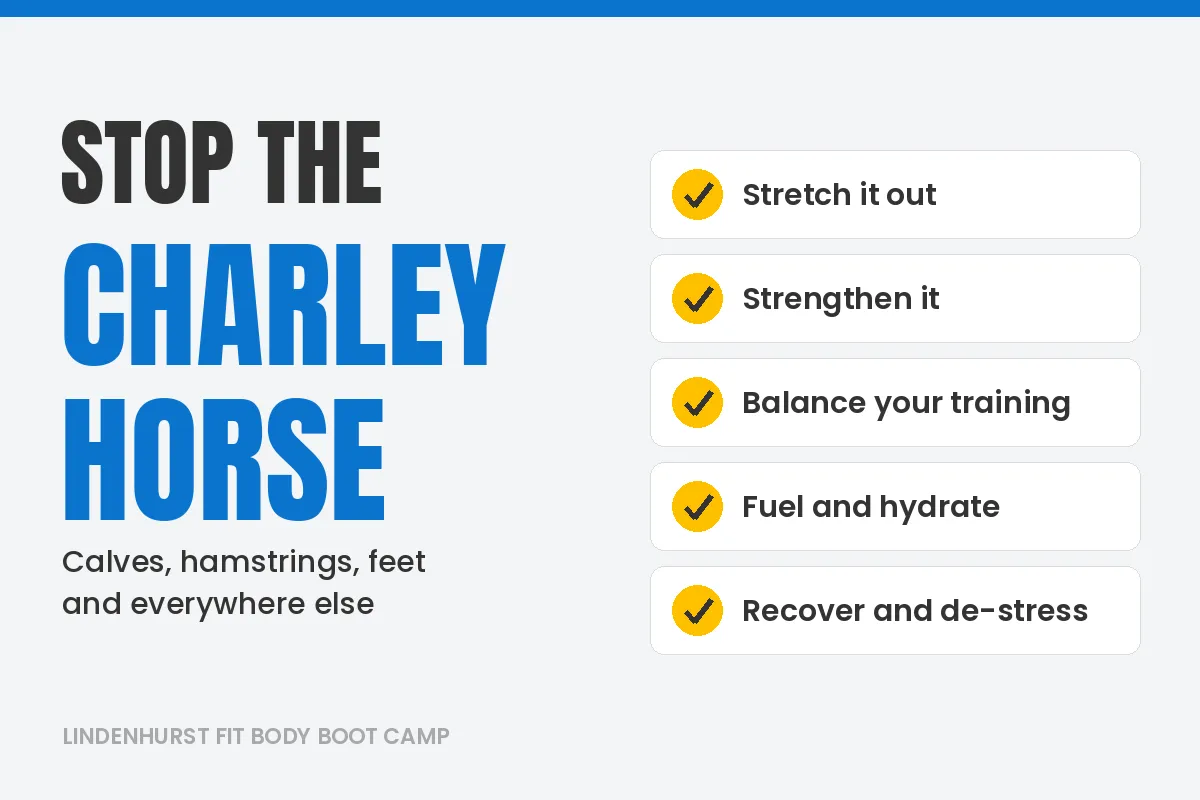
Your Cramp Prevention Plan
Pick the pieces that match your pattern. Most people need two or three of these, not all of them.
1. Strengthen the muscle that cramps
This is the fix most people skip. A stronger muscle handles more work before it tires out. If your calves cramp, train them on purpose with slow calf raises, both with straight knees and bent knees, since each version hits a different part of the calf. The same idea applies anywhere: hamstrings, feet, quads.
2. Balance your training
Train the muscles that support the one that cramps. For calves, that means the shins (toe raises) and the hips and glutes. For hamstrings, it means glutes and core. Check for side-to-side differences too. If one leg can do noticeably fewer reps than the other, that's worth working on.
3. Build up gradually
Increase your training volume or intensity a little at a time. Coming back from time off or starting something new? Ease in for the first couple of weeks instead of going all out on day one.
4. Keep your muscles and joints moving
Stretch the muscles that tend to cramp, especially before bed if your cramps hit at night. One study found that older adults who stretched their calves and hamstrings every night for six weeks had fewer and milder night cramps. Foam rolling can help loosen things up before a workout, but think of it as a warm-up tool, not a cure.
At night, loosen your sheets at the foot of the bed so your feet aren't pushed into a pointed position.
5. Recover like it counts
Sleep is when your muscles rebuild. Protect it. Take rest days, and pay attention to stretches of the week when work stress, long days, and hard training all pile up at once.
6. Fuel and hydrate for your day
Eat enough to support your training, especially protein and carbohydrates around workouts. Drink water throughout the day, and if you're a heavy sweater, replace your sodium on hard training days. An electrolyte mix like Hydration Sticks is an easy way to do that.
Magnesium deserves an honest word. Many adults don't get enough from food, and stress may lower it further, so eating magnesium-rich foods like leafy greens, nuts, seeds, beans, and whole grains is a smart move. A supplement like 1st Phorm Magnesium can help fill the gap. Just know the research hasn't shown that magnesium reliably prevents cramps on its own. Think of it as one support, not a fix.
7. Manage the stress load
You can't always shrink your to-do list, but you can give your body more ways to recover from it: a short walk after work, a few minutes of slow breathing before bed, and keeping your workouts on the calendar. Exercise is one of the best stress relievers there is.
When to See a Professional
Most cramps are harmless and respond to the steps above. But some symptoms need a licensed medical professional, not a foam roller.
Get checked right away if you notice:
Swelling, warmth, or redness in one leg, especially the calf. This can be a sign of a blood clot.
Leg pain that comes on while walking and goes away when you stop. This can point to a circulation problem.
Cramps along with numbness, tingling, or weakness.
Book an appointment with your doctor or a physical therapist if:
Your cramps are frequent, getting worse, or waking you up most nights.
They started after beginning a new medication.
You have pain in a tendon or joint, like the back of your heel or ankle, that doesn't improve within a couple of weeks.
The steps in this article haven't helped after a few weeks of consistent effort.
A good coach can help you get stronger and train smarter, but some problems need a diagnosis first.
The Bottom Line
If you've been drinking more water and eating bananas and the cramps keep coming, it's time to look at the bigger picture. Notice when and where your cramps hit, match that pattern to the likely causes, and work on the pieces that fit you. For most people, that means building stronger, more balanced muscles, easing into new training, protecting sleep, and fueling the day properly.
Want more tips like this delivered straight to your inbox? Join our newsletter here.
See you in class,
Mike
